How do you get stability? Use negative feedback.
Negative feedback is everywhere: parents use it to discipline children, your body uses it to regulate your blood glucose levels, and central banks use it to control inflation. Negative feedback is required to achieve stability, while on the other hand positive feedback is more often used to induce instability. Positive feedback is also common: it occurs in viral memes, bank runs, and in physiological processes like blood clotting.
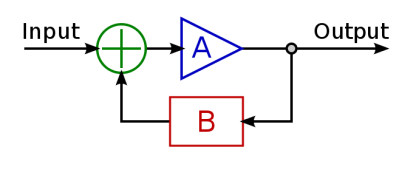
The field of closed-loop control is devoted to studying the dynamics of feedback, with the most important topic being the stability of a system. As an example, in a person with a healthy pancreas, insulin is released when your blood sugar is high, which reduces it and is critical in maintaining your blood sugar at a stable level. In the figure below, think of your body as “A”, the input being what you eat, the output being your blood sugar, and your pancreas as the block “B”, which monitors your blood sugar and releases insulin as required to keep it stable.
Negative feedback is used in economics: central bank typically acts against the direction of the economy. It lowers interest rates when the economy is headed down to stimulate it, and raises interest rates when the economy is robust to restrain it. A central bank’s goal is to maintain a stable economy.
The words “negative”and “positive” as I am using them are not value judgements, rather they describing the way a system behaves. Even so, if a person or group are the thing we’re trying to make stable, they will definitely notice when feedback is negative. Children do not like being disciplined and markets do not like moving from low to high interest rates. In many cases it is tempting to remove the feedback, and go open-loop, or at least reduce the amount of negative feedback. This is a dangerous and can lead to instability.
How do you get stability? Use negative feedback. “How much negative feedback is required for stability?” you ask. Well, there’s a whole field of engineering, control theory, dedicated to answering that question.
 chrispeel.net