Economic growth and the Danish model

I enjoyed this interview from DW News with Philippe Aghion, winner of the 2025 Nobel in Economics. In the interview he advocates for a Danish-style social safety net as a mechanism that allow creative destruction: i.e. technological growth without leaving people behind. I made a transcript of the last four minutes, with some edits for clarity:

Interviewer: “Do you think in the age of Trump what’s happening (say in the US) is something fundamental or are these superficial changes?

Aghion: “I think they’re fundamental. I don’t think they will disappear if Trump is no longer in power and I think a lot of that is because (the US) didn’t have a flex security system (like) Denmark. Many people suffered from the technological transformation and for globalization. Had they implemented a system like in Denmark, I think there would have been much less demand for populism more generally.”

Interviewer: “I see you have (had) this journey from being involved in the communist party to moving towards enhancing capitalism.

Aghion: “So in fact I will tell you something when I was (young) my role model was (Enrico) Berlinguer. He was a very open communist leader and in fact he was for the historic compromise which was a compromise with the Christian democracy. They … became good social democrats. I keep having that in mind as a role model in the same way as the world has changed. I mean we now know that communism as a system doesn’t work, that it produces a lot of drama, a lot of undesirable things, but we on the other hand the communist parties in western Europe were defending workers and pushing for more social justice and more social mobility. But we know you can achieve social mobility through social democracy or social liberalism. Call it the way you want. So I still want shared prosperity and I want growth which is friendly. That’s why I like the flex security system. I want creative destruction which is socially geared. You see what I mean? I believe that the free market economy is the better system and economy. I believe very much in democracy, in a good social model, in green (policies), but the market economy so far is the system that that allowed us to achieve those. But I want a market economy which takes the social element seriously. So I am Schumpeterian but… You see what’s very interesting is that if you adopt Danish flex security you make creative destruction work better. It enhances innovation and at the same time you protect individuals. So it’s not that you have either-or. It’s not that you have to be either for innovation or for social protection and inclusion. You can do things that will make you both more innovative and more inclusive. For example more education means that you have more people who can become innovators; a good education system is good for inclusiveness and for you innovation-based growth and competition. More competition means that more entrants can come in; that boosts social mobility. So you boost innovation and you boost social mobility. So I don’t believe that you have to oppose (either) the goal of achieving social mobility and the goal of achieving more growth through creative destruction.”


To me, this means that social programs like universal basic education, universal basic health care, and maybe even (!!) universal inclusion in the gains of capital would allow a more robust and thriving sort of capitalism.

No Kings or No Science

The US (and the world?) seems to be debating now whether we should have “No Kings” or “no science”. The former term is used in recent protests against Trumps styling himself as “king” in marked contrast to the resistance of George Washington to being monarch. “No Science” is my label for threatened or actual defunding by the Trump administration of NASA missions, particle physics and gravity wave detectors, and efficient cars. This fundamental science is important, but more damning is changes that will result in Americans being ‘sicker, poorer, and dying younger.’ Of course there’s more subtleties that could be discussed and hairs to be split, yet brevity is useful at present:

I am for funding science, and against kings in the US.

How to pay for a war

Ukraine is fighting a war of survival; how is the war being paid for? We know that Ukraine is actively looking for funding from the West, but is it also funding the war with income tax increases? For context, what did the US do in past wars? Below I show that the US dramatically increased ordinary income tax rates on middle and (especially) high incomes during wars, while Ukraine has only recently made a 3.5% increase in its flat income tax.

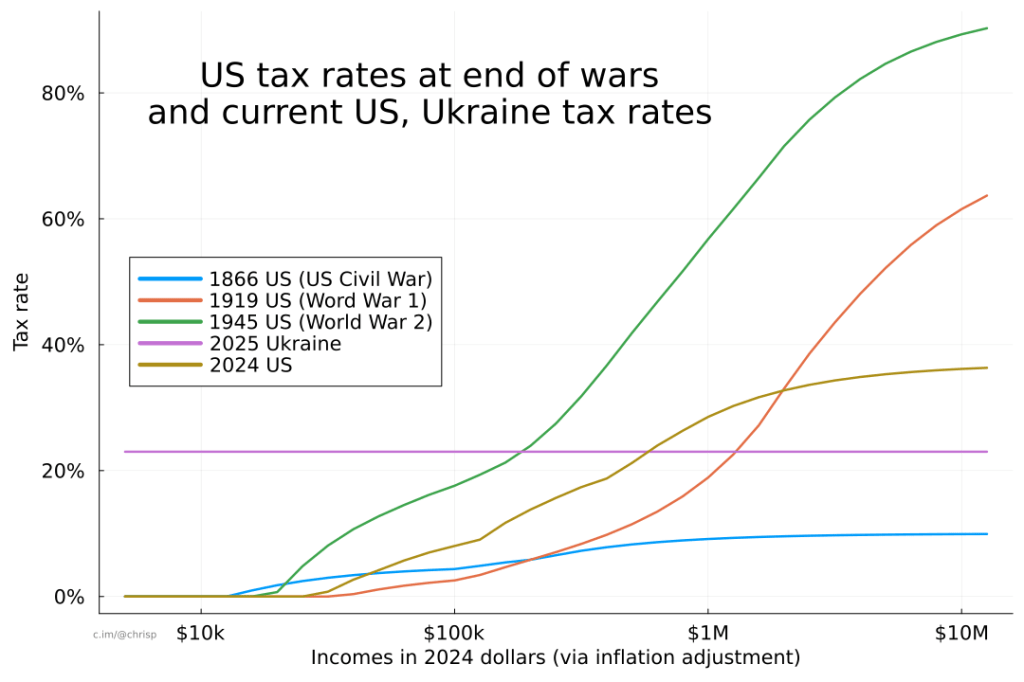
The first income tax in the US was put in place by the Union during the Civil War (the Confederacy opted for bonds and struggled to fund the war). The blue curve below shows the difference in effective (average) income tax rates from before the war 1860 to 1866 in 2024 dollars (since there were not income taxes in 1860, this curve also shows tax rates in 1866). After the Civil War the income tax was ended, and not reinstated until right before World War 1, when after intense debate the passage of the Sixteenth Amendment allowed a federal income tax. The red curve shows the dramatic increase in US income tax rates from 1915 to the end of the war in 1919. These tax increases were most dramatic on annual incomes between $1M and above (in inflation-adjusted dollars); the tax increased an eye-opening 50% on ordinary incomes of $10M! During World War 2, income tax rates also increased (though from a higher base, more on that later), as shown in the green curve; the increase were much larger for middle incomes during WW 2 than for WW 1. The data for US income tax in the figures below come from taxFoo.jl and does not include FICA (social security and Medicare) payments, tax credits, capital gains tax, or state taxes. Incomes in the plot below are shown on a logarithmic scale.

So, what has Ukraine done during the current war with Russia? Until last month there had been zero increases in the income tax. Finally in October 2024 the Ukrainian government raised the military tax on income 3.5% (for 2025 taxes), retaining its flat nature. In sharp contrast, one hundred and fifty years ago the US raised taxes 10% on the wealthy (with no taxes on low incomes) to fund a (somewhat similar) internecine war, and raised taxes even more on high incomes during the world wars. Many post-communist countries in Europe and Asia also have flat taxes; Ukraine appears to have made zero steps towards a western-style progressive tax structure, even during a war of survival. Of course such taxes would be more complex, and are not a panacea. Raising taxes on the wealthy is a common tool used by Western countries during war; is it too much to think that Ukraine should do so?

The final figure (below) shows effective tax brackets for the US at the end of the US Civil war and the two world wars, and the current US and Ukrainian tax rates. As before, all incomes are inflation-adjusted to be in 2024 US dollars, with no purchasing-power-parity calculations. Social security (pension) payments are not included, nor are tax credits; when including these US taxes remain progressive, while Ukrainian tax rates become regressive. While the Ukrainian income tax will be 23% in 2025, in the US at the end of World War 1 the top marginal rate was 73%, and was 94% at the end of World War 2 (these are the values which the red and green curves are asymptotically approaching at high incomes).

Ukraine has been asking the United States and other western countries with progressive tax structures to send military and financial aid, while it keeps a relatively low tax on high incomes. An opponent of the war in the US might say “The wealthy and middle class in the US are funding this war, while the most wealthy in Ukraine are paying a low rate! Why should the US fund this war when the wealthy in Ukraine are not willing to sacrifice like the wealthy in the US did during the US Civil war or the world wars?” I support continued funding from the US for Ukraine, yet I have some sympathy for this critique. I would like to see Ukraine explicitly put more of the burden of financing this war on residents with higher incomes via a more progressive income tax. This would be a wonderful signal to the world that Ukraine wants to move towards self-sufficiency, are interested in Western institutions, and want to minimize oligarchy. Such progressive taxes could be continued after the war, where they would induce more trust in government, reduce inequality, and even make more people willing to pay taxes.

I support Ukraine. I want Ukraine to win this war. I hope the tax change listed above will be considered by Ukrainians as a mechanism to help win the war and also win the subsequent peace.

“The Great Tax Wars”

I just finished reading “The Great Tax Wars” by Steven R. Weisman. From the first income tax during the Civil War through WWI, this book describes the (familiar!) debate about how progressive the tax system should be, and even whether or not we should have an income tax.

I found the themes and arguments in the book to be relevant to our day, though often 160 years old. Yes, the topic is pretty dry, and I did get bogged down in some of the debates, for example about the sixteenth amendment. Instead of any more of a review, in what follows I give a few quotes from the book, each with a bit of context. Though Google Books for some reason does not allow links to all quotes from the book, when allowed such links are provided.

The book starts with the Civil War, including the first use of a mildly progressive income tax by the Union to pay for the war. During debate in Congress, some Republicans supported a progressive tax: “I think it is just, right, and proper that those having a larger amount of income shall pay a larger amount of tax,” declared Representative Augustus Frank, an upstate New York Republican” (p 84). In contrast, the Confederacy resisted using an income tax, and the taxes it imposed were regressive. It seems that the basic idea of taxation was a tough one for the South: “The sorry story of financing the Confederate cause raised the question of whether a government that believed in decentralization and states’ rights could mobilize the resources to prosecute a war. The South was caught in the paradox of its own politics” (p72).

Not all of the book is dry wonkiness. On p 92 we read that soon after Lincoln’s second inagural, he visited Richmond where “word spread of his presence, and soon he was surrounded by throngs of former slaves, shouting, ‘Bless the Lord, Father Abraham’s come.’

After the war, wealthy interests moved against the income tax: “The income tax is the most odious, vexatious, inquisitorial, and unequal of all our taxes” the New York Tribune said in 1869 (p97). In contrast, Grover Cleveland gave the following provocative quote in a speech to Congress at the end of his first term (p112): “the communism of combined wealth and capital, the outgrowth of overweening cupidity and selfishness, which insidiously undermines the justice and integrity of free institutions, is not less dangerous than the communism of oppressed poverty and toil.

Citing stats from Thomas Shearman, on p 123 we read “Since 1860, federal taxation had increased sixfold, yet the tax burden was primarily borne by the poor. At the same time, corporate profits had increased tenfold, much of it untaxed. It cost rich Americans 8 to 10 percent of their earnings to finance the government, while the poor paid taxes equivalent to 75 to 80 percent of their savings.”

On p 201, we read a quote from Theodore Roosevelt that sounds like support of a progressive wealth tax: “I feel that we shall ultimately have to consider the adoption of some such scheme as that of a progressive tax on all fortunes, beyond a certain amount“. My guess is that Roosevelt was thinking more of an inheritance tax, rather than a Piketty-style wealth tax.

Roosevelt saw the wealthy as having significant responsibilities (p 202): “One interesting aspect of this message was that Roosevelt was embracing an argument going back to the Civil War: the wealthy man, he said, enjoys unusual protections from government and therefore has “a peculiar obligation to the State because he derives special advantages from the mere existence of government.

The book covers the debate about the sixteenth amendment, which explicitly allowed an income tax. For whatever reason I have no quotes from this debate, only a quote about the first income tax after the amendment’s passage, from p 278: “On May 8, 1913, the House approved with surprisingly little
controversy the first income tax law that would actually take effect since 1872, when the Civil War era taxes were repealed. … Taxing (only) incomes of more than $4,000 meant that the tax would affect only the wealthiest 3 percent of the population.

On p 306 Cordell Hull is quoted: “An irrepressible conflict has been raging for a thousand years between the strong and the weak, and the former always trying to heap the chief tax burdens upon the latter. That conflict still continues.

On p 309 we read about a study conducted around 1916: “One study, by an independent group of academics, union leaders and some business representatives called the Industrial Commission, endorsed the view that labor unrest stemmed form the unequal distribution of American wealth. It cited the fact that forty-four families earned an aggregate income of $55 million, whereas factory and mine workers earned less than $10 a week. Basil M. Manly, the commission’s research director, spoke of the “industrial feudalism” of the Rockefellers, Morgans, Vanderbilts and Astors. He urged an inheritance tax limiting inheritances from any estate to $1 million.” $1M in 1916 is about $30M in 2024.

On p 343, speaking about the 1920s, we read “… the heroes of the decade were to be the business giants lionized as the agents of what looked like permanent prosperity to the American political landscape. Wilson’s New Freedom was all but forgotten. Whereas in 1912 the nation had turned drastically to the left, perhaps without realizing it, eight years later it turned drastically to the right.

On p 346, speaking about WW1 and the income tax: “… the tax structure would not have occurred without the war. One of the ironies of history was that out of the devastation of civilization as it was known, came the dramatic creation of a vibrant tax and economic system that Americans live with today. Only a war could drive tax rates, even for a tiny minority, from an extremely modest 7 percent at the outset of the conflict to the astounding level of 77 percent on the wealthiest Americans.

In the Epilogue, the last paragraph of the book reads “A long time has pased since the Civil War, when Representative Justin Morrill compared the enactment of the income tax to Adam and Eve being expelled from their ‘untaxed garden’ and forced to make their solitary way in the world. We may yearn to return to the Garden of Eden, but we have learned that taxes are the price we pay to live in the real world, cope with its dangers and meet the needs of a modern nation. Even to establish Paradise on earth, we will have to pay the way.

UPDATE: I made minor clarifications on Dec 9 2025.

Ukrainian income taxes

I support Ukraine during the current war; though they are receiving significant foreign aid, revenue from income tax remains a big part of their national budget. This post reviews individual income tax in Ukraine for everyday people and for a class of entrepreneur. I show effective tax rates vs income for these two classes and for US taxpayers. While US income taxes are progressive, Ukrainian taxes are flat or even regressive when social security taxes are included.

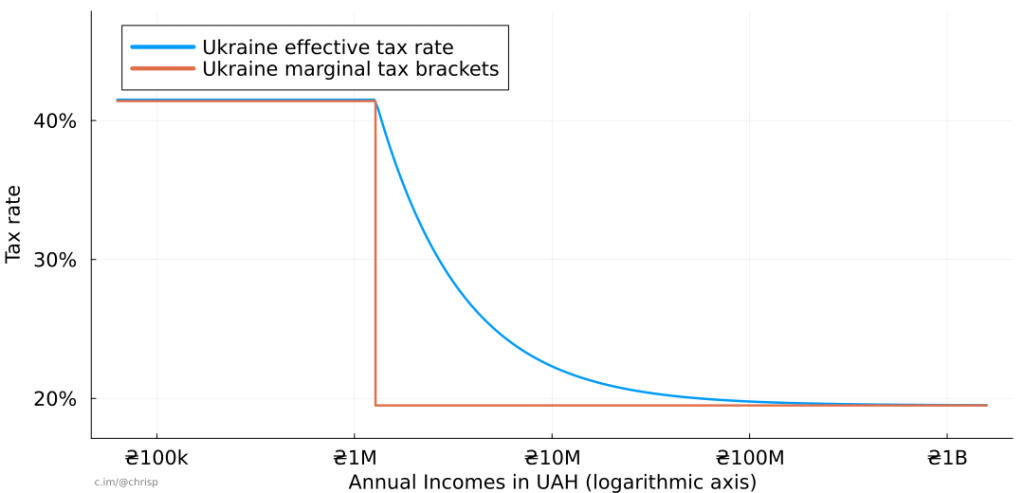
Basic Ukrainian income tax is nominally flat at 18% on all income for residents and non-residents. Employees also pay a 1.5% military tax (which will be raised to 5% in 2025), while employers pay an additional social security tax of 22% on the first 1,440,000 Ukrainian hryvna (denoted by ₴ or UAH in what follows) of income each year for each employee. The figure below shows in red that the marginal tax rate is 41.5% (18% + 1.5% + 22%) below ₴1,440,000, and is 19.5% above that threshold, while the blue curve gives the effective (average) tax rate; in what follows we will focus on effective tax rates. Note that the horizontal axis is annual income shown on a logarithmic scale.

Why are we combining the employer-paid tax of 22% with the employee-paid tax of 19.5%? Even though the employee will hopefully get a specific retirement benefit from the Ukrainian government for such contributions, these contributions and benefits are not (to my knowledge) directly owned by the employee, and future laws could change the benefits provided. It also makes sense for an employer to look at what percent of their total payments (taxes + salary) for an employee actually end up in the employee’s pockets.

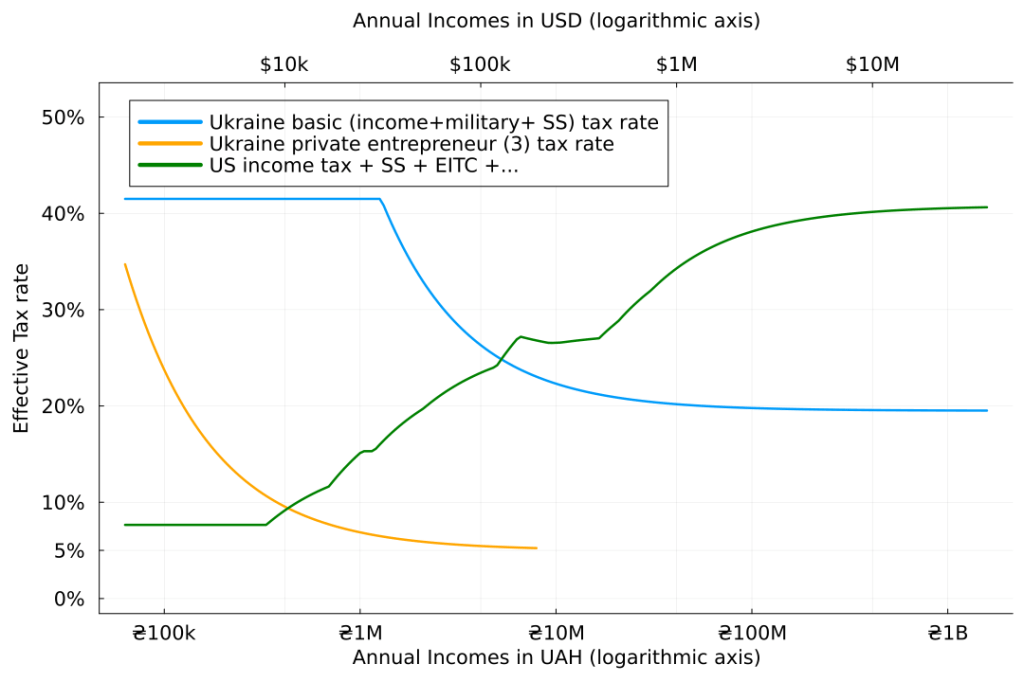
The next figure shows the same basic effective tax rate in blue, the Ukrainian effective tax rate for a class of entrepreneurs in orange, and (for comparison) the effective US income tax including FICA (social security and Medicare) and other taxes as calculated via Taxsim. While the Ukrainian tax brackets and numbers are for 2024, the US income tax is for 2023, since Taxsim does not yet have data for 2024. The US data are shown on the same plot assuming a conversion rate of $1= ₴41.28.

The “private entrepreneur 3, non-VAT” tax classification, for which the effective tax is shown in orange, is often used by IT professionals in Ukraine. For example, an international software company might have an entire division of “private entrepreneurs” working for it in Ukraine. These people will work in an office, have office parties, have an HR person to work with them, and function in many ways like ordinary employees, but for tax purposes will be contractors and will pay a much lower tax than other Ukrainians making the same wages. People in the specific entrepreneur tax class shown in orange pay a base tax of 5% of their income, and prior to the war also paid a minimum of a social security tax of 22% of the basic income (not 22% of their full wage as in the basic tax classification). The social security tax is optional during the war for these entrepreneurs (but not for ordinary taxpayers). This tax classification is limited to people earning less than ₴8,285,700 (about $200,000) per year. Recent legislation may change how these entrepreneurs are taxed in 2025, though the details are not yet clear.

There are many ways the figures above could be improved (if you see a mistake, please let me know). There are other tax classifications in Ukraine, and other details were omitted. Even so, I believe that the two individual income tax classifications shown above are enough to give a flavor of Ukrainian income taxes.

US individual taxes are progressive; low income people pay a low rate, while high income people pay a higher rate; this is the case whether one does or does not include social security taxes. Ukrainian income taxes are very different: with social security payments Ukrainian income taxes are regressive, without they are flat. I like the tax structure of the US much more than that of Ukraine: the US’s progressive taxes act to lower economic inequality, build a middle class, and stabilize society.


Dec 4 Update: In follow-up research I learned that the IMF has asked Ukraine to consider an individual income tax that is progressive. As another good sign, Ukraine’s National Revenue Strategy for 2024–2030 includes discussion of a progressive income tax. Finally, the current flat tax was implemented in 2004; before that it was progressive.

taxFoo.jl: Visualizing historical US income taxes

Taxsim is a tool from Daniel Feenberg for obtaining US federal and state income tax rates. It is powerful and versatile: it includes things like the core income tax, FICA taxes, EITC taxes, and COVID-era tax credits. Unfortunately it only goes back to 1960 for federal taxes. In an effort to visualize and understand US income tax rates back to its beginning during the US Civil war, I wrote taxFoo.jl. This is a barebones and simple package; it does not include capital gains taxes, EITC taxes, or tax credits. Even so, it does include core tax brackets, deductions, exemptions, and FICA taxes back to 1862, and matches Taxsim in many simple scenarios in the 1960s.

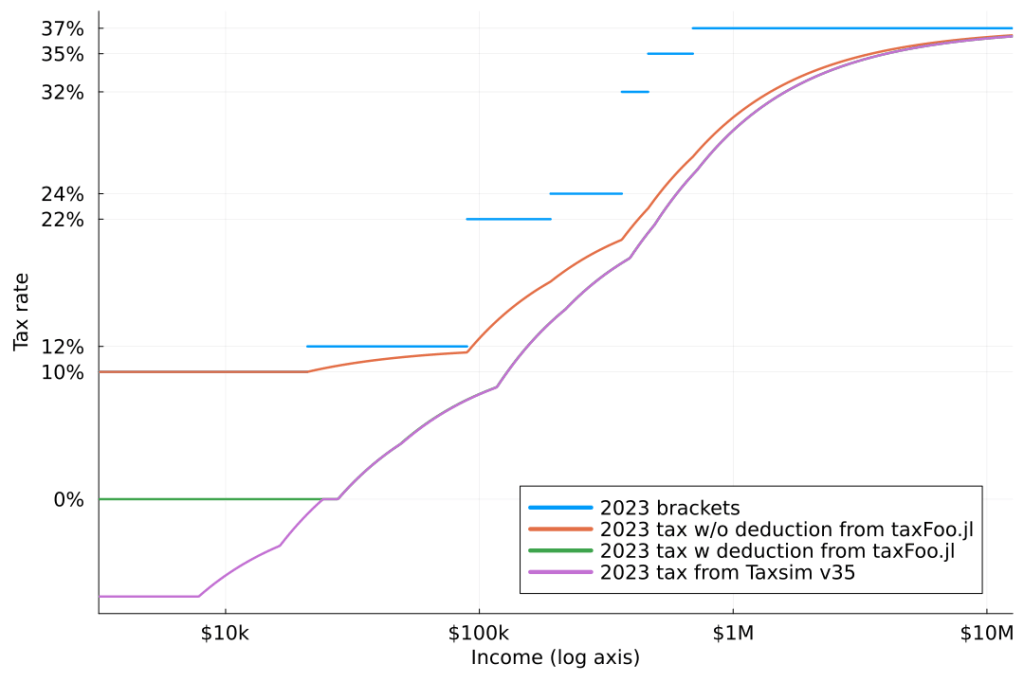
The plot above shows 2023 income tax brackets from, the effective tax rate implied by those brackets without any deductions, the effective tax rate with the standard deduction (all from taxFoo.jl), and finally the effective rate from Taxsim. All data are for the filing status “married filing jointly”, other filing statuses are similar. Taxsim includes the Earned income tax credit (EITC) which the taxFoo.jl curves do not; this is the reason for the difference between the Taxsim curve and the “tax w deduction from taxFoo.jl” curve at low incomes. In this plot FICA taxes are not included, while they are included in the figure below. The scenario used here is a simple one in which all income is wage income, with no other income such as capital gains. Note that the horizontal axis shows income on a logarithmic scale. We show the tax brackets for 2023 because Taxsim does not work for 2024.

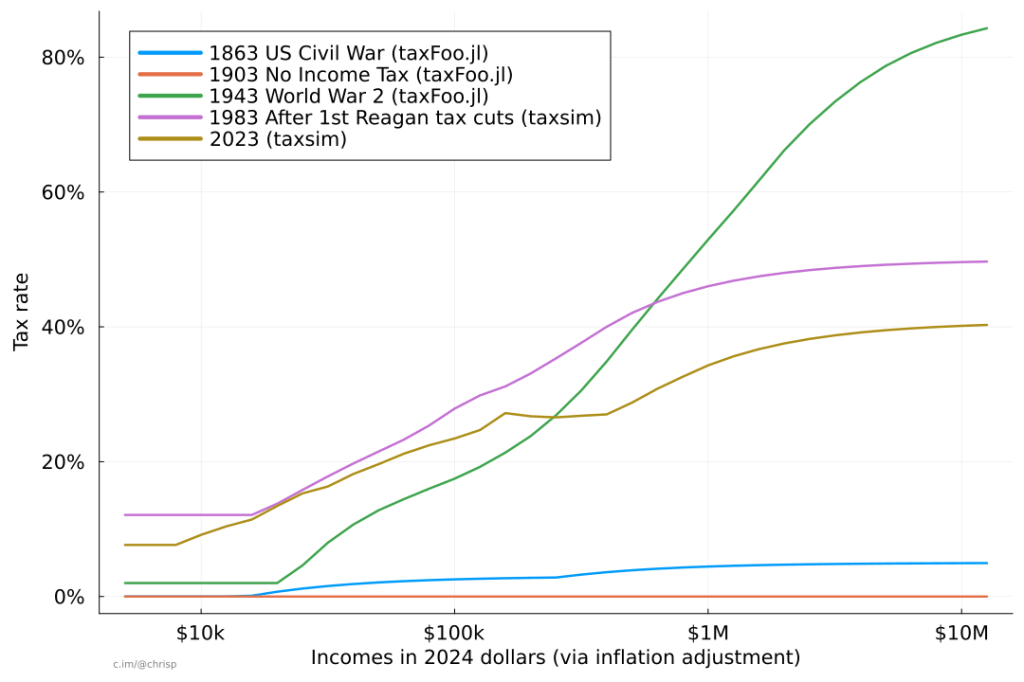
Taxsim is superior to taxFoo.jl in all years for which it provides data; unfortunately it simply does not provide data prior to 1960. Since the tax code has become generally more complex since 1960, it is generally an easier task to implement the tax code prior to 1960 than after, which is what taxFoo.jl attempts to do. See the taxFoo.jl Readme for an animated plot which illustrates US wage income tax rates from the start of the income tax in 1860 to now; unfortunately that animated graph is a bit hard to follow. The following graph shows a subset of the full dataset: the income tax every forty years from 1863 to 2023. The income values are all inflation adjusted to 2024 dollars. The scenario is again a married couple filing jointly with only wage income (other filing statuses are similar). Social Security and Medicare (FICA) taxes in the form of employee and employer contributions are included for all years in which they are in effect (after 1937).

The figure shows the relatively low income tax during the US Civil war when the income tax was first implemented. After the war the income tax was repealed, and the US went back to funding the government via tariffs; thus we see no income tax in 1903. In the late 1800s and early 1900s the income tax was a hot topic, culminating in the 16th amendment which was ratified in 1913. In the figure, the wartime 1943 curve is the sole representative of the era from 1917 to 1980s of higher taxes on the highest incomes. Finally, in 2023 we see a rate curve that is representative of recent tax rates. In the figure, taxFoo.jl is used for 1863, 1903, and 1943, while Taxsim is used for 1983 and 2023

Before thinking about how we might change the tax policy in the US, it is useful to look at how our taxes were structured in the past. Until a better tool gives data for all years, I’ll use taxFoo.jl for tax data prior to 1960, and Taxsim after 1960 to understand tax data.

Hey Elon, Make Twitter a non-profit

I would love to see Elon Musk convert Twitter into a 501(c)(3) non-profit with a diverse board and a membership model. This would improve his image and that of Twitter, be more attractive for advertisers, help to retain users, and is a better model for a niche product.

Twitter is a text-based niche platform that is not valuable for advertisers the way Facebook is. It doesn’t seem reasonable to expect that Twitter will grow by having everyone become an active user and thus become a more attractive for advertising. How will Twitter make money? One option is to not even try. I suggest that Musk not look at Facebook as a model, but Wikipedia. I suggest he one-up another billionaire, Paul Huntsman, who turned the Salt Lake Tribune into a non-profit.

The idea: Musk buys out the other owners, then converts the company into a non-profit with a board that is diverse enough to appeal to a wide range of people. Journalists, the political left, the right, and free-speech advocates should all be able to find someone appealing on the board. Musk loves publicity, and this would likely bring a positive spotlight. If there’s enough positive publicity from such a large donation and reason to expect the platform to be neutral, advertisers will return, and users will be more willing to consider paying a membership fee, especially if it’s tax-deductible.

There are all kinds of problems with this: Is Musk willing to make such a massive donation? Who will pay the debt: Musk or the non-profit? Would the negative publicity and chaos that have surrounded Musk’s acquisition be reduced enough to bring back advertisers? Steve Waldman is concerned that such a non-profit would induce a bias to the algorithmic feeds to satisfy big donors, or otherwise be corrupted by them. This is a raw, crazy idea that I guess will not happen. Musk loves raw, crazy ideas; I hope he does it.

Let’s put a low-pass filter on the market

The long-term price of an asset carries the most information; financial advisors consistently tell investors to ignore short term fluctuations. Day-to-day changes in prices are less useful than the long-term trend and can depend on rumors, collective hallucination on social media, or a billionaire’s bet. More capital gains brackets, with high taxes on short-term, and low taxes on long-term gains would act to smooth out day-to-day noise in prices and focus investors on the long-term health and growth of companies.

In signal processing, a low-pass filter is one that passes low-frequency signals, and rejects (stops) high-frequency signals. For an example, think about the seven-day average of COVID-19 cases for specific areas; these averages filter out the day-to-day variation and reveal longer-term trends. In this case and in other signal processing applications, the low-frequency trends are informative, while the high-frequency changes are noisy. Capital markets need a low-pass filter.

In the US we have a not-so-great filter in the form of normal income taxes on capital assets held less than a year, and lower taxes on assets held longer than a year. The red line in the figure above illustrates current US capital gains taxes. Investors are incentivized to hold their assets for at least a year, after which selling the asset will give them their lowest tax rate. Operators of high-frequency-trading bots who hold assets for only microseconds get the same rates as those who hold for 11 months, while those who hold assets for 13 months get the same tax rate as those who hold assets for 40 years. This seems wrong; my understanding is that long-term investments are much more likely to lead to jobs and allow technical innovation. Long-term investments would allow executives to focus on long-term growth.

In 2015 Hillary Clinton proposed significant changes to the capital gains taxes. Even earlier, in 2012, conservative Clayton Christensen proposed something similar, suggesting that this would force more money into long-term investments and reduce the “billions in capital … sitting inert and uninvested.” The blue curve in the figure below represents these ideas, even if it does not capture the details from any proposal. I like these proposals, yet I think we can do more.

An even better idea is to increase capital gains taxes on assets held for less than a year as illustrated with the green curve, and add more long-term brackets. I am assuming in my discussion that the tax change would be revenue-neutral; someone smarter than me would have to determine the right values for the taxes so that we don’t end up raising more or less revenue than at present.

What would happen with the proposed long-term incentivizing tax? One result is less trades would happen; isn’t this obviously a bad thing? No, Hal Varian has said he thinks there are too many trades. There would be less liquidity in the markets, yet Steve Waldman has noted that “Liquidity isn’t apple pie“. He also suggests that lowering the number of noise (short-term) trades would lower costs for long-term trades. I believe the long-term-incentivizing tax would result in much less day-to-day or week-to-week variation in the prices of assets; the tax would act as a low-pass filter on markets. The main impact of the tax change would be much more of a focus on the long-term health and growth of companies.

I don’t pretend to have given a detailed proposal; for example it may be that having many capital gains brackets is appropriate only for people with incomes over (say) $150k/year. I also don’t pretend that what I suggest is new, or even that my post will have any but the tiniest of impacts on the world. Even so, when I find a public policy that I like such as this (or a more progressive income tax) I like to note it and share it with a few family and friends. Please let me know if you find politicians working on such tax policy; I’m willing to donate.

I’ll vote conservatively (for Biden)

I’ll vote for Joe Biden in the 2020 presidential election. Here are a few details

  • I voted for Elizabeth Warren in the primary, and like her tax policy; Biden is more fiscally conservative than Warren yet at least he’s rational about economic (and racial) inequality.
  • Biden is a safe, small-c conservative choice. He’ll be more boring than Trump. He will not troll his opponents, tear down American institutions, or tweet at 3am. He won’t make the big changes that Bernie Sanders and AOC would like to make.
  • Biden is often awkward, yet I have a basic level of trust in him. His opponent is not trustworthy, and not compassionate in any way.

Biden will be dramatically better for the country; I hope you’ll vote for him as well.

Economic policy I believe in

Economic policy has a big impact on our lives. I believe the following changes to U.S. economic policy would have significant benefits. To start with, I give three changes to the tax structure that can be made in a revenue-neutral way, then three tax changes that would increase revenue, and finally three new programs that could be funded with the increased revenue.

  • A return to the more progressive income tax rates of the 1960s with higher rates on higher incomes would reduce inequality and increase social stability.
  • A more progressive capital gains tax with more brackets such that we have low tax rates on assets held for longer term (say 10-20 years) and higher taxes on assets held for shorter terms, say a week. This would encourage companies and individuals to invest for long-term gain.
  • Convert the health care tax break from an employer tax break to an individual tax credit. I.e. move health care to be something that an individual manages, not an employer.
  • A tax on wealth above $50M.
  • Only allow a mortgage tax deduction on the first $150k of a mortgage.
  • A carbon tax. Say 50% on coal and oil.
  • Just like universal education, we should provide universal healthcare to our citizens. Let’s start with low-cost preventive care by nurse practitioners.
  • A new federal program to pay sales tax for in zip codes with residents in the lowest income quintile.
  • A universal stabilizing income that is nominally at some low level, (say $50/month/person) where the Fed or some similar quasi-independent body has authority to increase this during an economic downturn.

All of these are good ideas on their own; doing them together provides several synergies. A more progressive income tax, a wealth tax, reduced mortgage tax deduction, universal health care, and the sales tax program would all reduce economic inequality and will increase social stability.

Of course I didn’t give enough details and do not pretend to be a tax guru. This list is not a complete economic policy; merely something to talk about with me when you see me next.

Edited 7 Sept 2020 for grammar and readability.