I’ll vote conservatively (for Biden)

I’ll vote for Joe Biden in the 2020 presidential election. Here are a few details

  • I voted for Elizabeth Warren in the primary, and like her tax policy; Biden is more fiscally conservative than Warren yet at least he’s rational about economic (and racial) inequality.
  • Biden is a safe, small-c conservative choice. He’ll be more boring than Trump. He will not troll his opponents, tear down American institutions, or tweet at 3am. He won’t make the big changes that Bernie Sanders and AOC would like to make.
  • Biden is often awkward, yet I have a basic level of trust in him. His opponent is not trustworthy, and not compassionate in any way.

Biden will be dramatically better for the country; I hope you’ll vote for him as well.

Economic policy I believe in

Economic policy has a big impact on our lives. I believe the following changes to U.S. economic policy would have significant benefits. To start with, I give three changes to the tax structure that can be made in a revenue-neutral way, then three tax changes that would increase revenue, and finally three new programs that could be funded with the increased revenue.

  • A return to the more progressive income tax rates of the 1960s with higher rates on higher incomes would reduce inequality and increase social stability.
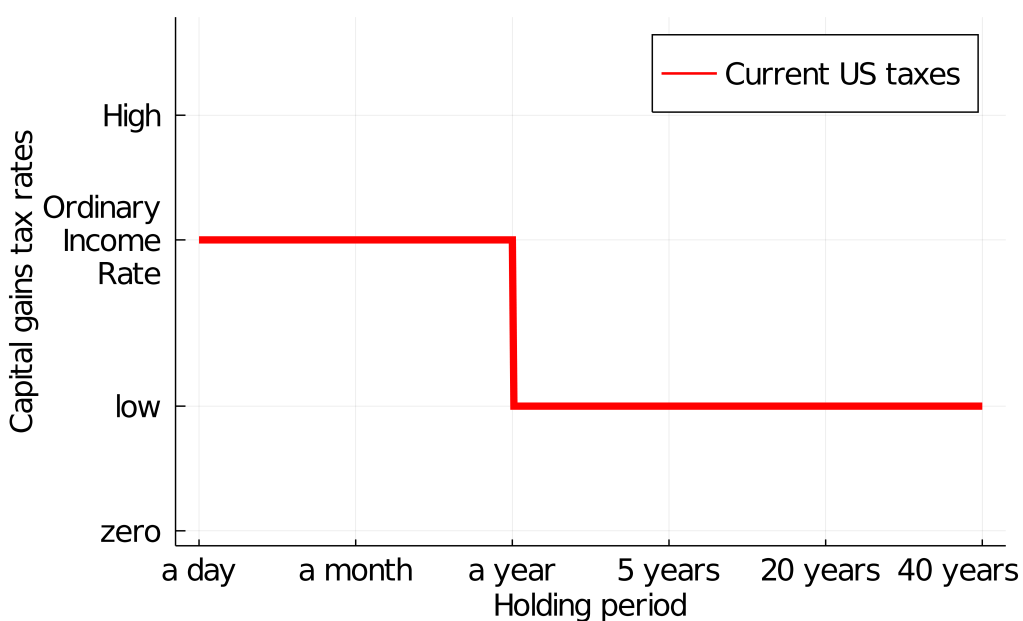
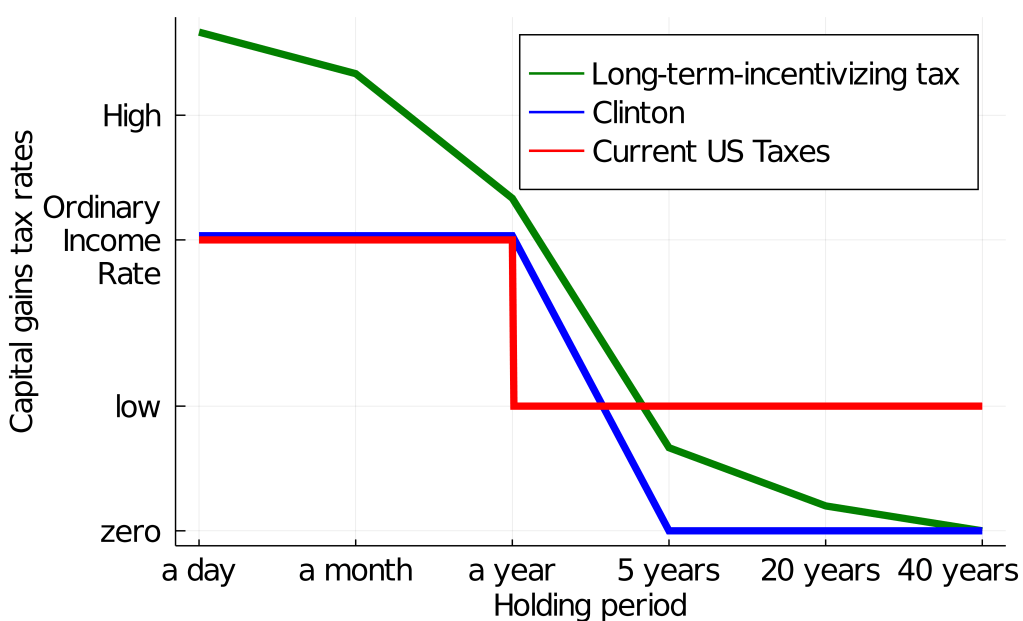
  • A more progressive capital gains tax with more brackets such that we have low tax rates on assets held for longer term (say 10-20 years) and higher taxes on assets held for shorter terms, say a week. This would encourage companies and individuals to invest for long-term gain.
  • Convert the health care tax break from an employer tax break to an individual tax credit. I.e. move health care to be something that an individual manages, not an employer.
  • A tax on wealth above $50M.
  • Only allow a mortgage tax deduction on the first $150k of a mortgage.
  • A carbon tax. Say 50% on coal and oil.
  • Just like universal education, we should provide universal healthcare to our citizens. Let’s start with low-cost preventive care by nurse practitioners.
  • A new federal program to pay sales tax for in zip codes with residents in the lowest income quintile.
  • A universal stabilizing income that is nominally at some low level, (say $50/month/person) where the Fed or some similar quasi-independent body has authority to increase this during an economic downturn.

All of these are good ideas on their own; doing them together provides several synergies. A more progressive income tax, a wealth tax, reduced mortgage tax deduction, universal health care, and the sales tax program would all reduce economic inequality and will increase social stability.

Of course I didn’t give enough details and do not pretend to be a tax guru. This list is not a complete economic policy; merely something to talk about with me when you see me next.

Edited 7 Sept 2020 for grammar and readability.

I’ll vote for Warren in the primary; here’s why

I’ll vote for Elizabeth Warren in the upcoming California presidential primary because of her tax proposals and values.

First, why not vote for a Republican or candidate from another party?  I am not registered with any political party, yet the Democratic Party aligns best with my values. They are concerned about climate change, inequality, and education. If I had lived in the 1950s to 70s, I may have voted Republican, yet now the GOP denies climate change, ignores inequality, and in general seems to be in thrall to a conman-in-chief.  I align with many libertarian values, yet the Libertarian Party is weak on inequality and climate change, and doesn’t have electable candidates. I hope in the future that I can find candidates from the Republican or other parties that I can vote for.

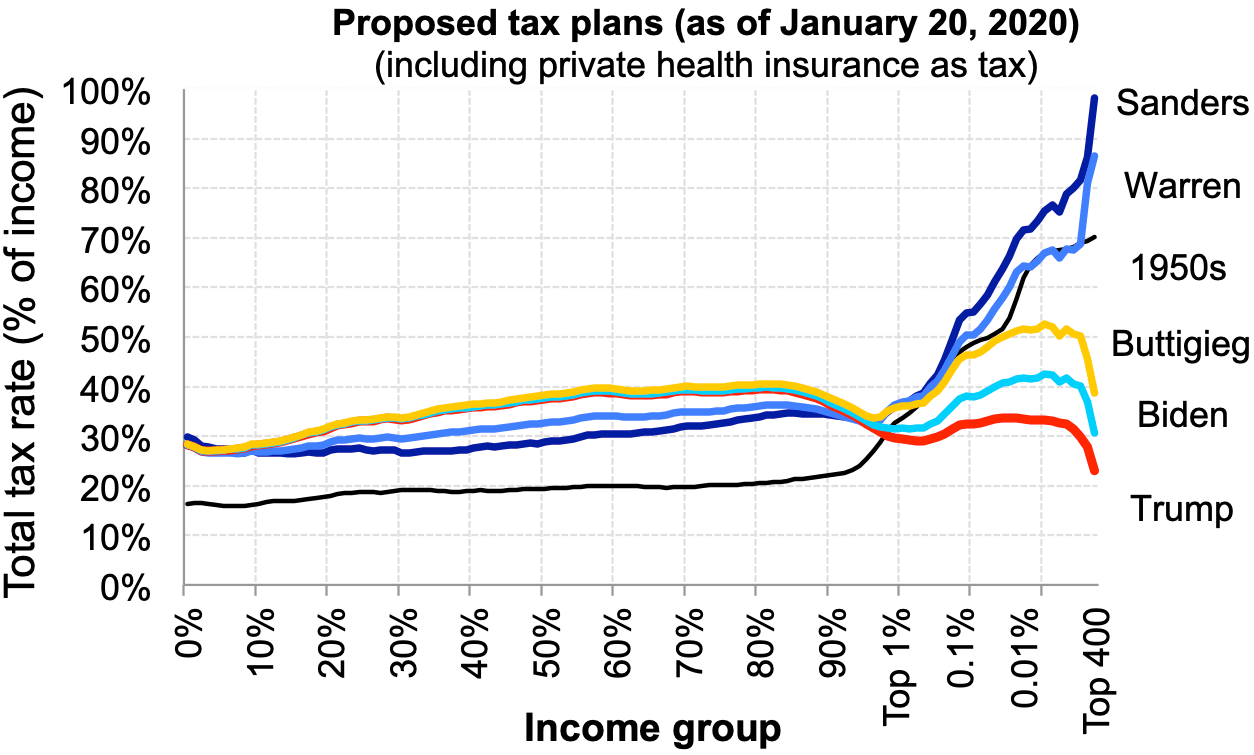
The Warren policy I’m most happy with is her tax plan which includes a more progressive income tax, and a wealth tax on the ultra-rich.  For these super-wealthy people, her tax plan aligns well with the tax structure of the 1950s; see the figure below.1 Her plan is dramatically better at stabilizing the income distribution than our current tax code; the net effect of her proposal is a feedback loop that encourages the growth of the middle class. In the current system, which includes Trump tax cuts for the rich,  the lowest income people pay a higher rate than the ultra-wealthy.  While Biden’s tax plan is better than the current system, it still gives the ultra-rich a lower tax rate than the middle class.  One thing that I wish one of the candidates would have done is lower the tax for the lowest-income people to 1950 levels or lower.

2020 Democratic Candidate Tax policies. Bernie Sanders and Elizabeth Warren have tax policies that match the 1950s for the ultra-rich, while Trump and Biden have the lowest rates for the ultra-rich.

Why tax the rich so heavily; doesn’t reducing their taxes result in a trickle-down effect on the economy? No, this is a myth.2 I described previously how progressive taxes (which inherently tax the wealthy more than the poor) push more people into the middle class. I believe a strong middle class makes for a much more stable society; I also believe that we should have programs to enable the people in the lowest income brackets to work their way into higher brackets; i.e. to increase income and wealth mobility.

Why not vote for Bernie Sanders?  His policies are similar to Warren’s, he understands the problem of inequality, and arguably is the one who created the progressive side of the Democratic party, so why don’t I just vote for him?  Because I trust Warren more than I trust Sanders.  He seems more inflexible and less likely to compromise.  Also, his policies are more extreme; I’d prefer that we reduce whiplash by not switching from an authoritarian to the most left-wing candidate.

I don’t support Warren on everything.  I’m very cautious about the “Medicare for All” program that Sanders and Warren support. Neither the advantages nor cost seem to me to be as clear as one would like for such a massive change from the present system. I don’t like her idea of the government producing generic versions of drugs.

Of course there is more to say.  This post is certainly inadequate for a full discussion of the candidates. I also don’t pretend to have been especially articulate. I’d be happy to talk with you about all the stuff I left out when I see you next.  Please change my mind 🙂


  1. The figure comes from the “taxsimulator2” spreadsheet from Zucman and Saez. I combined the “1950s” curve from the “interface” tab with the figure in the showing the candidates tax plans.
  2. It is possible for a capital-gains tax change that would better take advantage of wealth and better approximate a trickle-down effect. See this article from Clayton Christensen for the basic idea.

Progressive income taxes stabilize the income distribution

How could we achieve a stable income distribution?  With a progressive income tax.

In the US, the rich are getting richer, while the income of the lowest income brackets are staying the same. The number of the rich and the poor are increasing; the distribution is not stable and we are moving more and more towards a two-class system, with a rich class, a poor class, and a shrinking middle class in between.

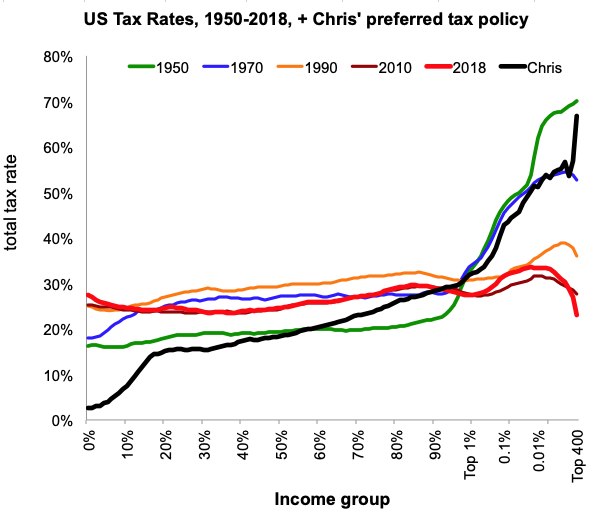
The obvious question is, why?  What is the reason for this dramatic change in the distribution of the money being made in the US?  I believe the main reason for the change is the dramatic change in the income tax rates between 1970 and 2020 as illustrated in the figure below (data from Zucman).  In 1950, the US taxed the lowest income bracket a full 10% less than now, and taxed the highest income brackets much more, up to 70%. As a reminder, the 1950s were a time of strong economic growth; I think the tax structure was a critical part of that growth. Low taxes for low income people encouraged them to work more, while higher taxes on higher incomes could fund social programs and indicated that we preferred an additional dollar made by a lower income worker to an additional dollar made by a millionaire.

Screen Shot 2020-02-07 at 11.26.22 AM.png

These are total tax rates (income, capital gains, payroll taxes, wealth tax, etc…); the most dominant tax for the middle class is the income tax, for which a similar figure can be made (see 1970 and 2010 data for example).  Comparing this figure with the income growth figure from the previous post, it is clear (to me at least!) that the main reason for the rising income inequality is higher taxes on low-income earners, and dramatic lowering of income and other taxes on the wealthy. The figure above also shows what sort of taxes I’d like to see. I would like even lower taxes for the lowest income people (to encourage them to work), and about 1970s-level taxes on the wealthy.  I’m not married to these exact values; if I knew how to make this curve revenue-neutral, I would.

Why impose such high rates on the wealthy, especially the ultra-wealthy?  In combination with the lower rates for low-income people, a more progressive tax system such as I show in the figure says that we value an additional $10,000 made by each of 100,000 people more than an additional $1 billion made by a billionaire (note that $10,000 times 100,000 = $1 billion).  This tax system would encourage the lowest income people to work more, and to move into the middle class; it would also have the effect to move some of the riches down into the middle class as well.   It would reverse the tendency of our current system to shrink the middle class, and move everyone into either wealthy or low-income groups.  There are other reasons to have this progressive tax system (income effects inducing higher cumulative happiness, other moral arguments); I’d prefer to start with the direct effects discussed above.

Elizabeth Warren and other 2020 Democratic candidates for the president have proposed that we make the tax system more progressive. I support these efforts to make a stable income distribution. 

Of course I’m not an expert; other sources will have much more information. I wrote this to (if nothing else) show to family and friends that I think the tax structure is an important policy topic, and to indicate what I believe our tax structure should be. 

Please talk to me the next time we meet about this!


Update: The wobbles in my effective tax in the figure above between the top 0.01% and the top 400 are an artifact of the spreadsheet from Zucman that I used to generate the figure and are not something I actually recommend 🙂

The US income distribution is not stable

The US income distribution is not stable: the rich are getting richer and the poor are staying poor.

By “income distribution” I mean how many people make $1,000/year, how many make $10,000/year, all the way up to how many people make $1,000,000/year.  I’m talking about the probability that someone, say in the United States in 2020, has any particular income: a probability distribution. Often economists talk about income “deciles”, for example the lowest income “decile” is the  average income of that tenth of people in the US who make the least money; other times they will talk about the “top 1 percent”, or the hundredth of people who make the most money.

What sort of income distribution do we want?  My baseline goal is a stable distribution; i.e. there are about the same number of rich, middle-class, and low-income people over time. This stable distribution ensures that the number of low income people is not growing (of course I’d prefer it even better if we could eliminate all poverty; let’s save that for another day).  Unfortunately at present, the rich are getting richer, while all the rest stay the same, or even lose income. 

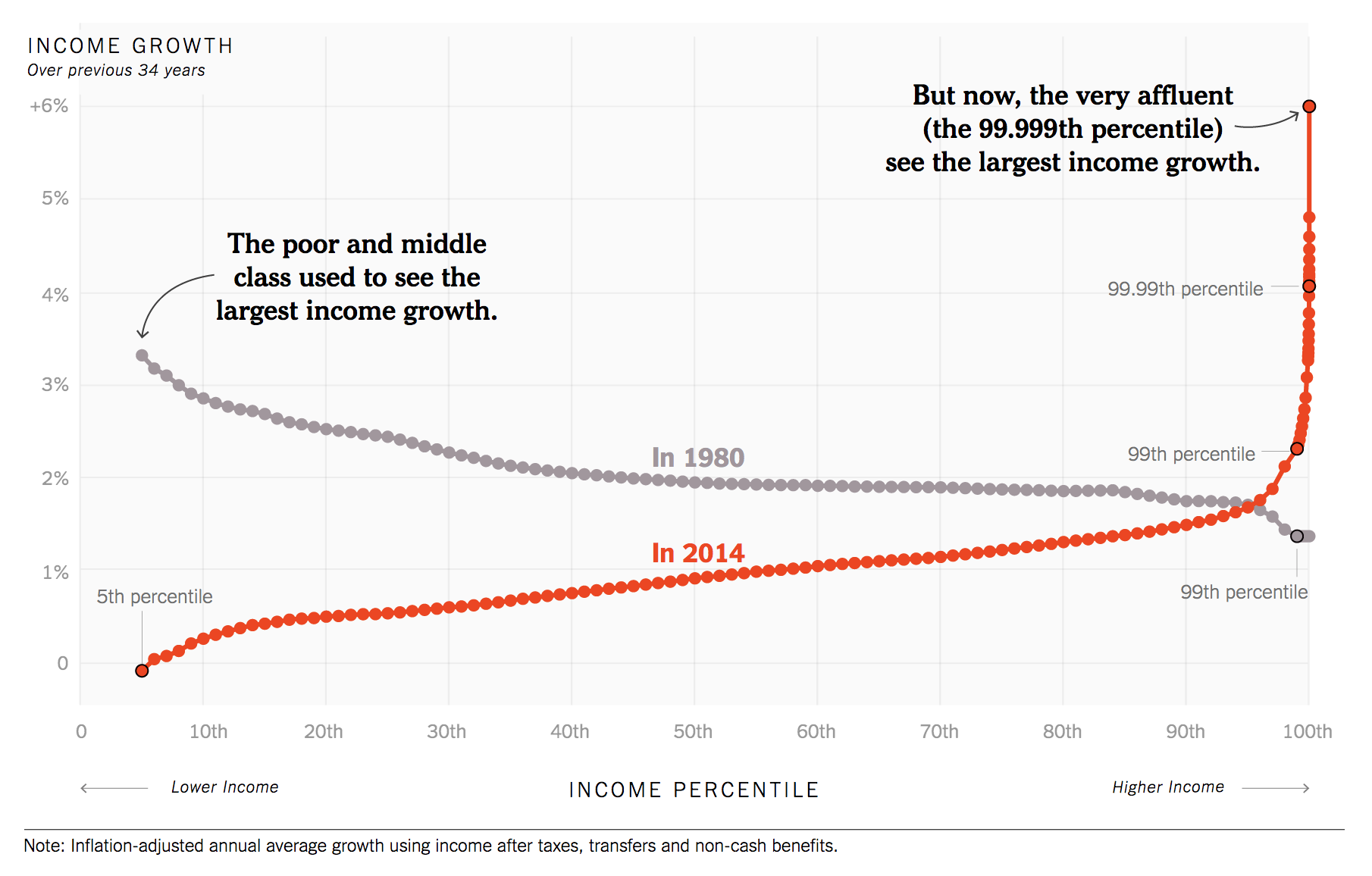
Piketty-Saez-Zucman-2016-1980-vs-2014.png

Many economists have described this growing inequality, for example Piketty, Saez, and Zucman; they used US government data to generate the figure above. In 1980, the people in the lowest income percentiles saw the largest income growth, higher than the richest people, who saw the lowest growth. This had the tendency to move the lowest income people, and the richest both into the middle class. Today, things are dramatically different; the people in the lowest incomes do not see their incomes grow at all: they see zero income growth. Meanwhile, the figure shows that in 2014 (I think it’s similar in 2020), the highest income people see the highest income growth each year. So the rich are getting richer, and the poor are staying poor, while the middle class shrinks.

This has been happening for the past forty years; let’s imagine this continues for another forty years.  The people in the lowest five percent are not increasing their income at all; they generally are not going to be able to move up. That five percent who are not making anything at all will become a much larger group, say 20%. The number of people who are rich will grow, and will continue to see their income and wealth grow. In forty years we will be dramatically more divided between rich and poor. There will be a dramatically smaller middle class. The income distribution in the US is not stable.

What can we do to fix this?  The easiest mechanism is to go back to something the income tax structure of 1970, which acted as negative feedback to make the number of people in the middle class stable.  The highest income people would pay something like 70% income tax, while those in the lowest income brackets would pay zero (or nearly zero) income tax. This would stabilize the income distribution. In my next post I’ll talk more about this progressive income tax.

Negative Feedback

How do you get stability? Use negative feedback.

Negative feedback is everywhere: parents use it to discipline children, your body uses it to regulate your blood glucose levels, and central banks use it to control inflation. Negative feedback is required to achieve stability, while on the other hand positive feedback is more often used to induce instability.  Positive feedback is also common: it occurs in viral memes, bank runs, and in physiological processes like blood clotting.

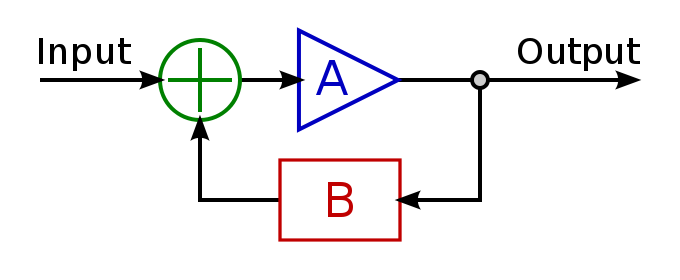
The field of closed-loop control is devoted to studying the dynamics of feedback, with the most important topic being the stability of a system. As an example, in a person with a healthy pancreas, insulin is released when your blood sugar is high, which reduces it and is critical in maintaining your blood sugar at a stable level. In the figure below, think of your body as “A”, the input being what you eat, the output being your blood sugar, and your pancreas as the block “B”, which monitors your blood sugar and releases insulin as required to keep it stable.

680px-Ideal_feedback_model.svg.png

Negative feedback is used in economics: central bank typically acts against the direction of the economy. It lowers interest rates when the economy is headed down to stimulate it, and raises interest rates when the economy is robust to restrain it. A central bank’s goal is to maintain a stable economy.

The words “negative”and “positive” as I am using them are not value judgements, rather they describing the way a system behaves. Even so, if a person or group are the thing we’re trying to make stable, they will definitely notice when feedback is negative. Children do not like being disciplined and markets do not like moving from low to high interest rates. In many cases it is tempting to remove the feedback, and go open-loop, or at least reduce the amount of negative feedback. This is a dangerous and can lead to instability.

How do you get stability? Use negative feedback.  “How much negative feedback is required for stability?” you ask.  Well, there’s a whole field of engineering, control theory, dedicated to answering that question.